
A Curious Shift in How Tasks Get Done
In today’s digital age, many of us rarely reflect on how complex tasks actually come together. We initiate things—submit forms, click buttons, send requests—and yet, behind the scenes, unseen systems make decisions, pass data back and forth, engage humans when needed, and ultimately deliver results. It’s a bit like expecting an orchestra to play a symphony without ever seeing a conductor or hearing the instrument tuning. Somehow, everything just flows.
This isn’t magic—it’s intelligent coordination. The modern enterprise is not just about scripts running or systems talking; it’s about orchestrating a dynamic interplay among AI-driven decision-makers, automated workers, and people. When done right, it translates to smoother experiences, fewer errors, and more time for us to focus on meaningful work.
When Systems Take Cues from Real Conductors
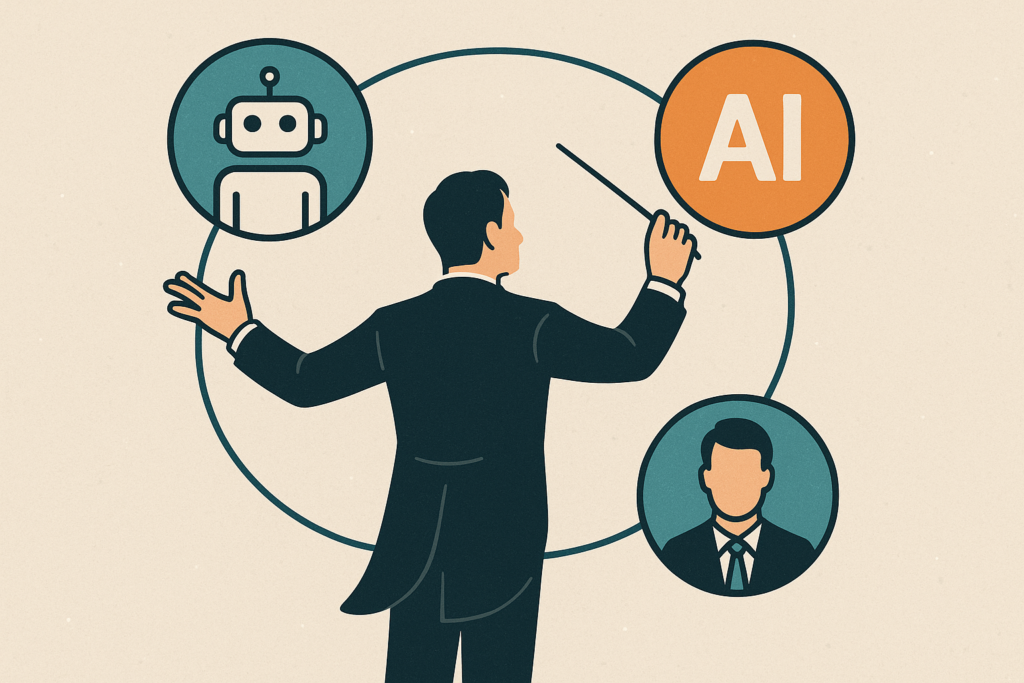
Imagine a conductor leading a symphony, directing various instrumentalists, adjusting tempo, ensuring each section comes in at the right moment. Now substitute the instruments with AI agents, RPA robots (think of them as tireless assistants handling repetitive routines), and humans stepping in when nuance or judgment is required. All of them act in harmony, guided by a central intelligence that keeps the tempo.
This is where agentic orchestration enters the picture—a subtle but essential shift from isolated automation tools to a unified conductor in the workflow symphony. It ensures that agents and robots aren’t just deployed—they’re aligned, monitored, governed, and connected. This orchestration not only improves efficiency but also ensures accountability and real-time adaptability across the entire automated ecosystem, reinforcing the strategic value of agentic orchestration.
Beyond the Buzzword: Real Work, Real Impact
Let’s ground this in something tangible. An organization dealing with claims processing or invoice approval might rely on countless steps: extracting information, validating data, escalating exceptions, notifying stakeholders. Previously, each step needed its own automation script—or a human handling exceptions. Now, imagine an intelligent layer that coordinates the entire journey:
- AI agent extracts and interprets data.
- If any ambiguity arises, a human reviewer steps in to validate.
- A robotic process completes structured tasks like API calls or updating systems.
- Finally, another agent drafts communications or flags follow-ups.
At the core, you’ve got a conductor that ensures each actor plays at the right time, with built-in oversight and performance tracking.
Why This Matters for Forward-Thinking Teams
For companies and IT teams grappling with automation fatigue or disjointed workflows, this orchestration model offers:
- Clarity: Instead of multiple siloed processes, you gain visibility across the entire flow.
- Trust: Knowing that humans can step in—and that systems operate under defined rules—builds confidence, especially in sensitive domains.
- Efficiency: Agents handle complex decisions, robots execute predictable routines, and humans focus on value-adding judgments.
That synergy—where agents think, robots do, and people lead—represents a new era of productivity. It’s powerful, and it’s already being adopted by organizations that recognize the value of structure wrapped in intelligence.
A New Era of Wayfinding, Not Just Automation
At its heart, this is a lesson about how tools shape behavior. When routine tasks are offloaded to robots, workers often end up slogging through exceptions. But when a system intelligently routes and orchestrates each step, what remains is thoughtful work—problem-solving, creative input, supervision. And this doesn’t just change roles—it changes culture.
A team that previously spent hours ensuring data consistency can now focus on insights, strategic improvements, or customer care. When systems are thoughtfully orchestrated, technology becomes a collaborator, not a hurdle.
Building with Confidence
Of course, integrating AI, automation, and people is not without risk. That’s why a robust orchestration layer must support:
- Business rule enforcement—ensuring agents act within guardrails.
- Auditability and traceability—seeing who did what and when.
- Real-time monitoring—to tweak, restart, or improve processes as they run.
- Human-in-the-loop flexibility—for review, escalation, and safety nets.
This controlled autonomy makes innovation safe. It’s not about unleashing unfettered AI agents; it’s about giving them purpose, boundaries, and alignment.
Wrapping Up: Conducting the Future of Work
In the end, the future of work isn’t about cold efficiency—it’s about intelligent harmony. It’s about orchestration that doesn’t feel prescriptive, systems that align without smothering, and workflows that flex while remaining reliable.
That invisible conductor—guiding agents, robots, and people—ensures the right notes hit at the right time. It rewrites what it means to automate, blending autonomy with oversight, speed with stability.
Welcome to the symphony of modern workflows; one where intelligent coordination takes center stage, and the people behind the music get to shine.